3-Man Weave Drill: Rules, Setup, and Common Mistakes
Setup
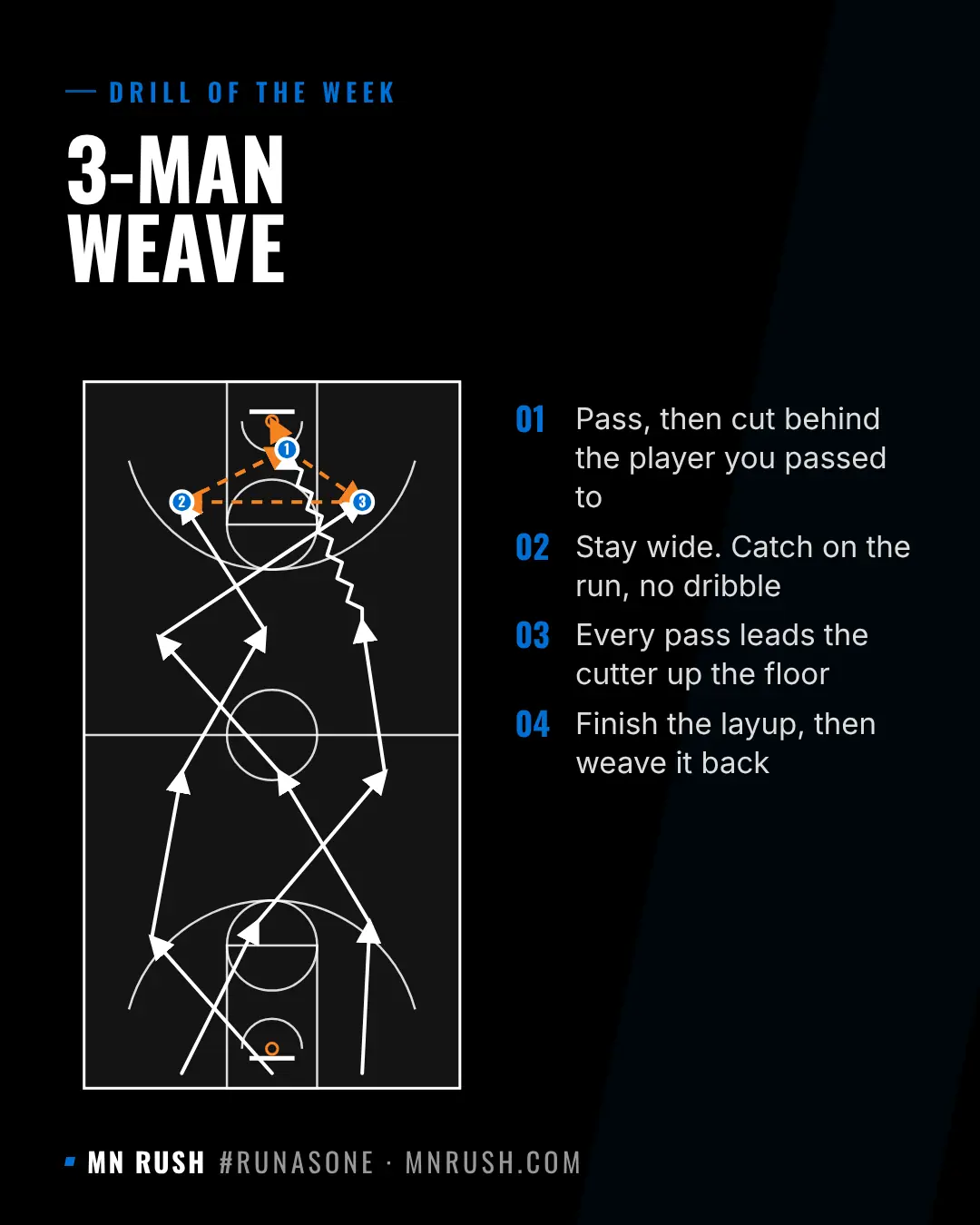
Three lines on the baseline: one in the middle with a ball, one on each sideline near the lane line extended. The middle player starts with the ball. The drill runs the length of the floor and finishes with a layup.
How the weave works
- First pass. The middle player passes to either wing and runs behind that player toward the sideline.
- Catch and pass. The receiver catches on the run, takes no dribble, and passes to the third player cutting toward the middle. Then he runs behind that player.
- Repeat. Every pass is followed by a cut behind the receiver. The three players weave across the floor as they advance.
- Finish. The player who catches near the far free-throw line drives in for a layup. The other two rebound and the drill comes back the other way, or the next group goes.
The rule that makes it work
Pass, then go behind the player you passed to. That is the whole drill. Players who go in front of the receiver, or who stop after passing, break the pattern for everyone. Coaches spend most of their weave time correcting this one thing.
The second rule is almost as important: stay wide. Players drift toward the middle as they get tired, which shortens the passes and makes the weave crowded. Make them touch the sideline.
Variations
- Number of passes. Require a set number of passes (three, five, seven) before the layup. More passes means more weaving in less space.
- No layup, shoot a jumper. Better for older teams. The last pass goes to a shooter at the elbow or wing.
- Weave and come back 2-on-1. The shooter stays, the other two defend... or the two rebounders attack the shooter 2-on-1 going back.
- 5-man weave. Same rule, five players, five lines. A conditioning drill as much as a passing drill.
Mistakes to correct
- Dribbling. There should be zero dribbles until the layup.
- Passing behind the cutter. Lead the receiver up the floor. A pass that makes him slow down is a bad pass.
- Jogging. The weave only teaches passing on the move if players move.
- Turning the ball over on the finish. A missed layup at the end of the weave means the drill restarts.
Frequently asked questions
Passing and catching on the move, running without the ball, timing between teammates, and conditioning. It is also a warm-up that forces players to communicate.
On a full court, three to five passes before the layup is typical. Younger players use fewer passes; older teams can require seven or more to force tighter weaving.
Yes, for players who can catch a pass on the run. Below about 4th grade, the timing is hard. For those ages, run a half-court version with two passes and a layup.
Related
Girls Program Director, MN Rush. Girls program director after coaching at the 13U and 14U levels. Former varsity assistant for North Branch Boys Basketball. girls@mnrush.com